


FOOD HISTORIAN Kat Romanow fell so in love with chopped liver and challah that she became a Jew.
“I converted, not for a partner, but because of food,” says Romanow, co-founder of The Wandering Chew, a Jewish food culture project. “Food is what got me into Judaism.”
Romanow had been studying religion and anthropology at Concordia University when the idea of focusing on Jewish food, improbably, grabbed hold of her. She had grown up Catholic and was raised in an Italian family — why not study either of those? “I have my theories about why I didn’t go that way,” says Romanow, hesitating a moment before explaining a painful crossroads in her family’s history.
Romanow’s maternal great-grandfather, Donato Monaco, immigrated to Canada from Italy in the 1920s. In 1932, along with brothers Vincenzo and Antonio, he opened the Corona Bakery, baking bread and pizza, and delivering it around Montreal by horse.
On June 10, 1940, as Mussolini was declaring war against Britain and France, Vincenzo was making his rounds. Vincenzo was arrested by the RCMP and his horse left to wander the streets, cart in tow. The three brothers were sent to an internment camp in Petawawa, Ontario. Like some 24,000 Japanese Canadians, German Canadians, and Italian Canadians, the Monacos were held under the War Measures Act, suspected of being fascist sympathizers and denied the right to trial.
Donato’s sixteen-year-old daughter, Mary, took over operations of the bakery. Eventually, a judge interviewed Vincenzo and found him “entirely innocent of any subversive act or intentions.” More suspicious was Vincenzo and Donato’s accuser, Augusto Bersani, a former minister of their Protestant church. Bersani’s name came up frequently enough in the judge’s interviews that he examined all cases in which detainees had been fingered by the former minister. Cast out of the church for allegedly embezzling funds and falsifying birth records, Bersani appeared to have been using his role as an RCMP informant to seek revenge on those he felt had wronged him.
Visiting the families of interned men, initially posing as a helpful friend, Bersani told Mrs. Monaco, “Remember when I was put out of the church? I suffered. Now your husbands are suffering.”
Just before Christmas of 1940, Donato and Vincenzo were released, though Antonio was held until 1943. The false imprisonment of a family’s entire generation of men is not something that happens without leaving deep wounds.
Donato’s son Leonardo worked in the bakery until it closed in 1995. Romanow grew up in the adjoining house; her grandfather made teething rings for her out of bread dough. “They were shaped like a bagel and were baked until quite hard,” she remembers.
It was a multigenerational home; the grandparents lived one floor above her. Every Sunday, they’d all have lunch together, the table set with spaghetti and tomato sauce. Sometimes there would be braciola, thinly sliced beef wrapped around cheese and herbs and simmered in tomato sauce. Always, there was the same bread. It was known then as zulu bread (see recipe on the next page for why we wouldn’t call it this today): a slightly sweet, oval loaf with a lightly golden crust and a soft and airy crumb. Occasionally dipped in sauce, it was primarily eaten on its own, sliced and spread with margarine.
At Concordia, Romanow studied under Jewish feminist activist Norma Joseph. “I thought I should know more about the religion I was always told Christianity/Catholicism was descended from.” Joseph told Romanow that she could study Jewish foodways and something clicked. From there she spent a summer at Brandeis University, after which she knew she wanted to convert.
“Alongside the research we were doing, we also went to Shabbat dinners, synagogues, and visited other Jewish institutions in the Boston area. After being immersed in Jewish culture and practice, I felt a connection to Judaism and began to explore conversion.”
In the years since, she’s had time to reflect on why she embraced the food and faith of Judaism, rather than the traditions she was born into. It goes back to her great-grandparents’ unjust imprisonment and the mark it left on her family.
“From what I understand — and it’s hard because my family never talks about this — on my mother’s side, there was a shift to downplay their Italian identity and be more Canadian English. I don’t exactly know what they were intending. So even though being Italian is a big part of my identity, at the same time, there were mixed messages from my mom, who would say, Don’t marry an Italian. Or my grandmother: she would always talk about ‘the Italians,’ not including herself.”
These days, challah is Romanow’s preeminent bread. On Fridays, she’ll bake a loaf, working to perfect her braiding technique. As a Shabbat ritual, she enjoys a hunk spread with butter, shares it with her four-year-old, then makes French toast with it over the weekend. During the week, her default bread is baguette, readily available in corner stores around her hometown of Montreal.
“It would be a very sad life without bread,” says Romanow. “Whether it’s slathered in a good jam for breakfast, or having a sandwich, or Friday night dinners. Not being able to do those things, there would be a bread-shaped hole in my life.”

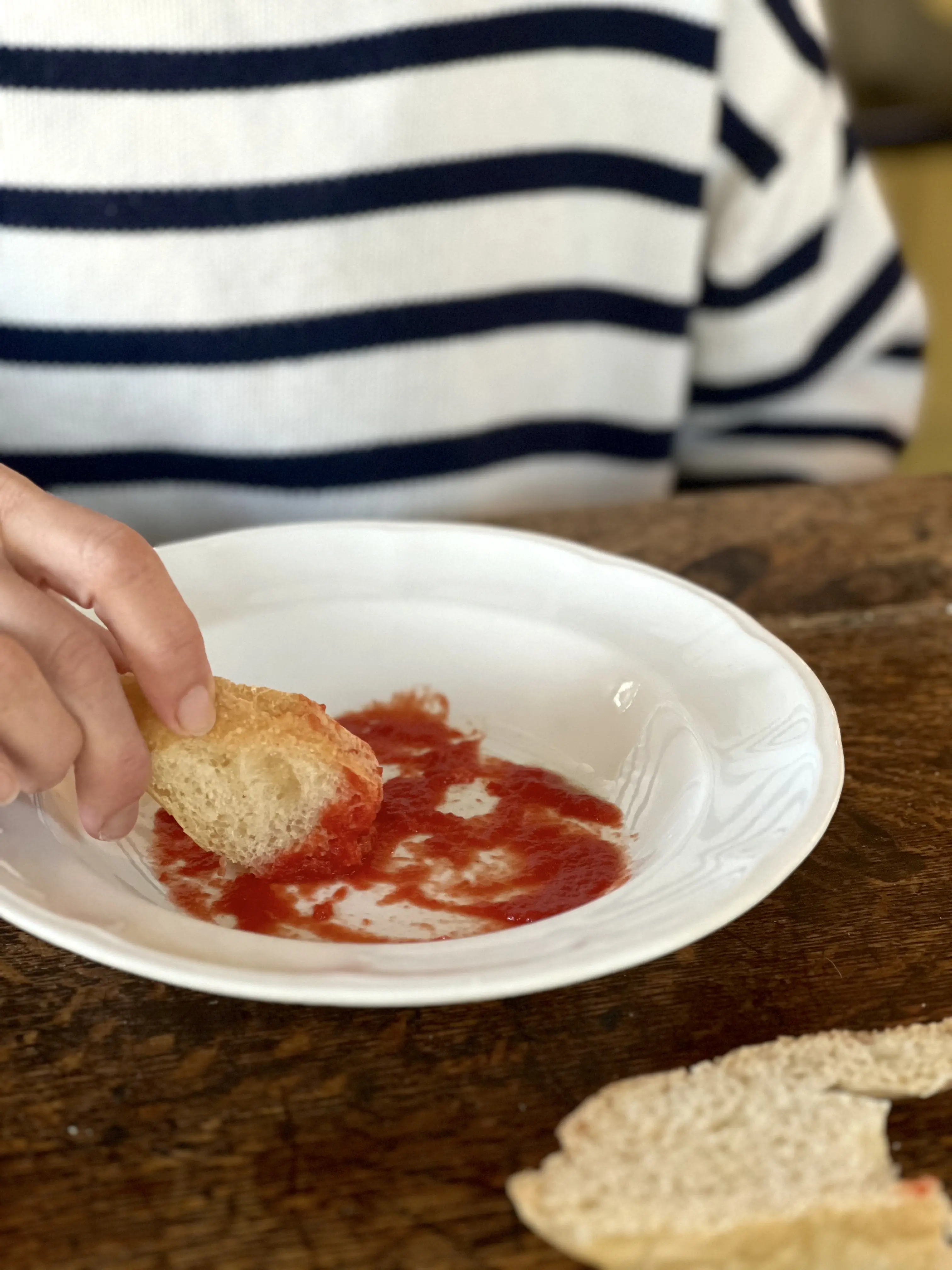
Pane Toscano
While challah and baguette play a huge part in Romanow’s life today, no one forgets their first love. The bread of her imagination, the bread of her heart, is the zulu bread that was the staple of her childhood. Unfortunately, the family recipe for it is lost. But working together, we’ve found, tested and adapted a recipe by Lynne Feifer that feels close.
Finding no reference to zulu bread outside of a couple of Quebec bakeries still making it today (spelled zoulou), I reached out to a chef friend, Dario Tomaselli. He’d never heard of it, and neither had the bakers he asked in Italy. He says zulu is often slang for “rough,” suggesting the term was likely used as a synonym for “unsophisticated,” a derogatory reference to the ethnic group of South African origin. We might do better to call it a Tuscan bread, while including a footnote about its history.
This recipe has a relatively low hydration rate (the percentage of liquid in dough, as measured by weight) of 39.2 percent, and is a testament to the magic of turning flour and water into bread. The dough takes a few hours to rise: perfect for weekend mornings when you can start a baking project before everyone else wakes, and have it warm and ready to eat around lunchtime.
Ingredients
- 356 g (1 ¾ cups) warm water
- 5 g (1 ¼ tsp) dry instant yeast
- 5.3 g (1 ½ tsp) salt
- 2.5 g (½ tsp) granulated sugar
- 2 g (½ tbsp) olive oil
- 550 g (4 cups) all-purpose flour, divided in two
Instructions
- In a small bowl, combine warm water and yeast. In the bowl of a stand mixer set up with the bread-hook attachment, combine salt, sugar, oil, and half the flour. When the yeast has bloomed (the grains will puff up and rise to the surface), pour it into the flour and turn the mixer to the lowest speed setting. After a few minutes, when the water is incorporated, add the remaining flour; continue mix on low speed for seven minutes, until a smooth, sticky dough forms. Let the dough rest for five minutes, then transfer to a lightly greased bowl. Cover with a cloth and leave to proof at room temperature for two hours. When it has doubled in size, tip the dough onto a parchment-covered cutting board and shape into an oval. (I form the ends into pointed tips to match Romanow’s description of the bread’s shape.) Let the dough rise for another 40 minutes, uncovered.
- Place a baking sheet in the oven and preheat to 450°F. Sprinkle a bit of flour over the loaf. With a sharp knife (or razor blade if you have it), make a vertical slash along the length of the loaf’s top, leaving a couple of inches at each end. Transfer the parchment with dough to the hot baking sheet. Bake for approximately 25 minutes. The bread is ready when the surface is copper-coloured and a knock on the bottom sounds hollow.
- Slice and eat immediately.




